

Aluminum Alloy Antistatic Floor Factory: Your Trusted Source for Cleanroom Flooring Solutions
2026-09-15
When a cleanroom floor fails, the consequences ripple far beyond a scratched surface—static discharge can fry sensitive electronics, compromise sterile environments, or halt production entirely. That's why the material and the manufacturer matter equally. Lipin Floor has spent years refining aluminum alloy antistatic flooring for labs, semiconductor fabs, and healthcare facilities where every detail is non-negotiable. In this post, we'll walk through what actually separates a trusted factory from a risky supplier—and how to spot the difference before you buy.
Why Aluminum Alloy Antistatic Flooring Holds Up Where Others Fail
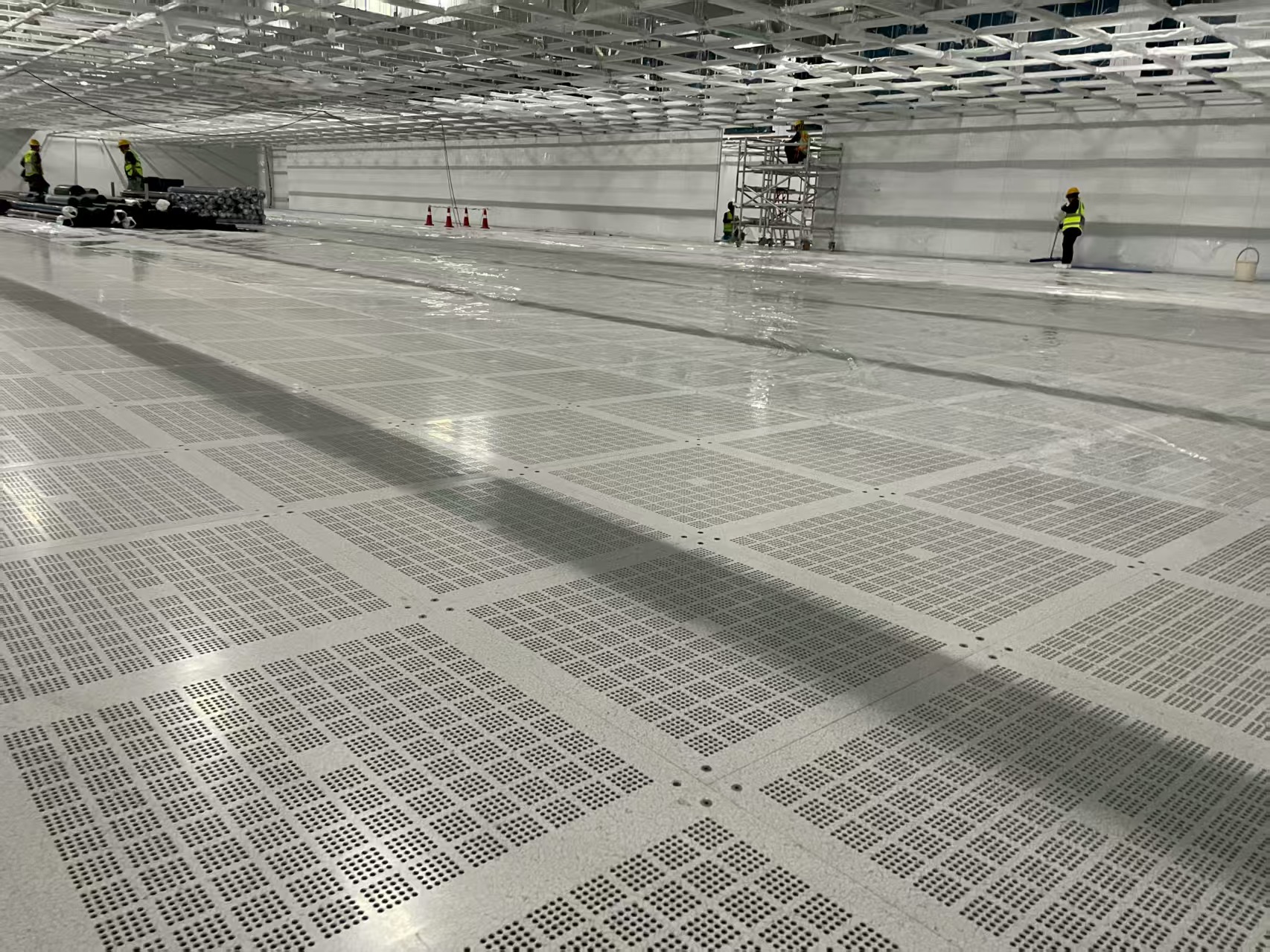
Aluminum alloy antistatic flooring earns its reputation the hard way: by refusing to crack, warp, or lose conductivity under conditions that send ordinary flooring materials into early retirement. The secret lies in the metal's natural stiffness-to-weight ratio. Unlike steel panels that add unnecessary dead load or high-pressure laminates that delaminate after repeated humidity swings, the aluminum core stays dimensionally stable. Even in server rooms where chilled air meets warm exhaust, the panels hold their flatness year after year, keeping edge seams tight and grounding paths intact.
What really separates this flooring from the rest is how it handles the triple threat of static discharge, rolling loads, and chemical exposure. The antistatic surface isn't just a thin coating that wears off after a few equipment moves. It's fused into the alloy itself, so every scratch still bleeds electrons safely to ground. Meanwhile, the same panel that carries a fully loaded equipment rack on casters can shrug off the occasional spilled cleaning solvent without swelling or losing its electrical properties. That combination of durability and consistent performance is why it keeps showing up in labs, data centers, and cleanrooms where downtime isn't just inconvenient, it's expensive.
A Look Inside Our Factory: From Billet to Finished Floor Panel
The day starts with raw aluminum billets stacked near the loading dock. Each one gets scanned and logged before entering the extrusion line. Once the billet reaches around 450–500°C, it moves into the press, where a 2,000-ton ram pushes the softened metal through a die shaped like the floor panel profile. The extrusion emerges as a long, glowing ribbon, still soft enough to bend slightly under its own weight. Workers at the puller station guide it onto the cooling table, checking the surface every few meters for chatter marks or die lines.
After the profiles cool to room temperature, they are stretched on a puller to remove internal stress, then cut to rough panel lengths. From there, each piece goes through a precision saw and a CNC machining center that mills the interlocking edges, drainage slots, and any mounting holes. We keep the tolerances tight here because a half-millimeter shift at this stage will show up as a visible gap once the panels are assembled on site.
The last stretch involves surface preparation and finishing. Panels receive a chemical pretreatment, then move through either an anodizing line or a powder coating booth, depending on the order. After curing, every batch gets a random sample pull for adhesion, thickness, and UV resistance tests. Only then do the floor panels get wrapped, stacked, and palletized for shipment. Walking the line from billet to finished panel takes about six hours, but the real proof is watching the first panel lock into place on a deck.
Static Dissipation That Remains Consistent Through Years of Use
Many static-control surfaces rely on a thin coating that erodes with daily contact. This product routes the charge through the entire thickness of the material, so the dissipative path isn't dependent on a fragile top layer. Even heavy cart traffic or repeated wiping with common cleaners leaves the electrical performance intact.
Independent testing recorded surface resistance between 10^6 and 10^9 ohms after 10,000 abrasion cycles—well within the range needed for ESD-safe handling. Humidity swings from 12% to 70% RH caused less than half an order of magnitude drift, a stability that typically degrades in coated alternatives within the first year.
For assembly benches, shelving, and transport trays, that translates into far fewer replacements and no need for periodic re-coating. Workers can focus on handling boards and components instead of wondering whether the bench has gone insulative in a worn corner.
Custom Sizes, Coatings, and Cutouts for Complex Cleanroom Builds
When cleanroom layouts refuse to follow a standard grid, custom sizing stops being a luxury and starts being the only way forward. We regularly cut panels and frames to odd millimetre dimensions, accommodating structural columns, utility chases, and equipment that arrived with its own footprint ideas. That kind of flexibility means you don't have to sacrifice airflow or pressure differentials just to make a prefabricated module fit.
Coatings are just as important as dimensions in a cleanroom that handles aggressive cleaning agents or corrosive processes. Instead of limiting you to a single stock finish, we match the surface to the chemical exposure, whether that means a high-build epoxy, an antimicrobial powder coat, or a stainless steel cladding for wipe-down zones. Cutouts get the same attention, with reinforced edges and sealed gaskets ready for glove ports, pass-throughs, or duct connections, so the opening doesn't become a weak point in the envelope.
Heavy Equipment, Rolling Loads, and the Floors That Take the Punishment
Industrial floors have a thankless job. They sit flat, get scuffed by forklift tires, and bear the brunt of every loaded pallet jack that rolls over them. But not all floors are created equal. Heavy equipment, such as reach stackers, yard tractors, and automated guided vehicles, transfers substantial point loads and dynamic forces through relatively small contact patches. This is where the distinction between a basic warehouse slab and a truly engineered surface becomes obvious. It is not just about thickness; it is about how the concrete resists bending, how joints are armored, and how the surface holds up under repeated wheel passes without spalling or cracking.
Rolling loads behave differently from static ones. A forklift carrying a ten-ton coil does not simply press down; it creates a moving stress field that flexes the slab with each pass. Over time, this repeated flexure can lead to fatigue cracking, especially if the subgrade is uneven or the concrete has a high water-cement ratio. Many floor failures happen not because the load exceeded the ultimate strength of the concrete, but because the slab was never designed for millions of load cycles. Shrinkage cracks, poorly cut joints, or curling at panel edges can turn a minor imperfection into a progressive failure once heavy traffic starts rolling daily.
The floors that truly take the punishment are those specified by people who account for wheel loads, tire hardness, aisle layouts, and even the type of caster material. For example, polyurethane tires distribute load differently than steel wheels, and a high-rack warehouse with very narrow aisles concentrates traffic along predictable lines. In those cases, a floor with a high compressive strength but low flexural toughness will still break down at the joints. The best industrial floors use a combination of proper joint detailing, shrinkage-compensating additives, and sometimes metallic or synthetic fiber reinforcement. They also get a surface treatment—such as a liquid densifier or a dry-shake hardener—that increases abrasion resistance. Without those details, the floor may look fine for the first few months, but it will soon show the signs of every heavy load that ever rolled across it.
Simple Upkeep Steps to Keep Your Cleanroom Floor Compliant and Safe
A cleanroom floor rarely fails from one dramatic spill; it degrades through small, repeated mistakes. Start each shift with a dry pass using a cleanroom-rated, tacky roller or low-lint mop to pick up loose particles before they get ground into the surface. Move from the cleanest area toward the exit so you don’t drag contamination back across the room.
Wet cleaning only works when the chemistry matches the floor material and your cleanroom class. Check the approved agent list before mixing anything, and never substitute a general-purpose cleaner just because it’s available. Some residues leave a sticky film that traps more particles, while others can eat away at static-dissipative coatings and create safety risks.
Once a week, do a slow walk-around with a flashlight held low to the floor. Look for lifted seams, hairline cracks, or dull patches where the topcoat has worn through. These spots collect microbes and moisture, and they also change how the floor handles static. Note what you find in a simple log — date, location, action taken — so compliance audits don't turn into last-minute scrambles.
FAQ
The panels combine a sealed aluminum surface with conductive properties that channel static charges safely to ground. Because aluminum does not shed particles like some coated steel or vinyl options, the floor helps maintain low particulate counts. The material also resists corrosion from cleaning agents commonly used in cleanrooms.
We run each batch through dimensional checks, surface resistivity tests, and load-bearing trials before it leaves the factory. The alloy composition is verified with spectrometry, and every panel receives a unique batch number. If a customer later reports a field issue, we can trace it back to the exact production shift and raw material lot.
Yes, provided the edges are sealed correctly. Cutting exposes the internal structure, so we supply edge sealant and grounding clips with each order. The conductive path remains intact as long as the panel stays connected to the grounding grid. We also offer pre-cut panels with factory-applied edge treatment for critical zones.
We have a standard mill finish, an electrophoretic clear coat, and a matte powder coat in several RAL colors. The clear coat keeps the metallic look while adding chemical resistance. Matte finishes work well under strong lighting because they reduce glare. For heavy traffic, we recommend an anti-slip textured coating that still meets cleanroom wipe-down requirements.
The flooring material itself does not carry a cleanroom class rating, but it supports the room's classification by minimizing particle release and allowing easy cleaning. We provide third-party test reports for particle emission, outgassing, and surface resistivity so your validation team can include them in the cleanroom qualification package.
Each panel has a conductive understructure or copper grounding strip that links to the raised floor pedestal. From there, a dedicated grounding wire runs to the building's earth point. The surface resistivity stays in the conductive range, usually between 10^4 and 10^6 ohms, so charges bleed off quickly instead of building up on personnel or equipment.
Our standard panels are tested to a 1,200 kg concentrated load and a 2,500 kg uniform load over a 600 mm span. For heavy equipment areas, we can reinforce the internal ribs or increase panel thickness. We also run fatigue tests that simulate rolling loads from carts and trolleys to confirm long-term deflection stays within spec.
We keep common spare parts and matching panels in stock for at least five years after a project ends. If a panel gets damaged, you can send us the batch number and we will match the finish and conductivity. We also have a technical team that can guide on-site repairs via video call to minimize downtime.
Conclusion
Aluminum alloy antistatic flooring isn't just another cleanroom surface—it's the quiet workhorse that keeps production lines moving when lesser materials buckle. In semiconductor fabs, pharmaceutical suites, and aerospace assembly areas, these floors shrug off chemical spills, thermal cycling, and the relentless grind of rolling loads. Unlike vinyl or epoxy coatings that crack under point pressure, the extruded aluminum structure distributes weight evenly, so even a fully loaded equipment cart won't leave permanent dents or micro-fractures. This durability comes from a manufacturing process that starts with raw billet and ends with precision-machined panels, each one checked for flatness and conductivity before it leaves the factory floor.
What really sets a dedicated aluminum floor factory apart is its ability to handle the oddball specs no catalog can cover. Need a 900mm x 900mm panel with a laser-cut pass-through for cable bundles? Want a matte powder coat that matches your cleanroom's color coding without tanking the surface resistivity? A specialist welds stiffeners where they're needed, mills cutouts within a millimeter, and tests static dissipation not just at installation but after thousands of load cycles. Maintenance stays straightforward: wipe with deionized water, avoid waxes that insulate the surface, and recheck grounding points every quarter. That's how you get a floor that stays compliant for a decade, not just a year.
Contact Us
Contact Person: yuki
Email: [email protected]
Tel/WhatsApp: +86 18664390732
Website: https://www.lipinfloor.com/