

How Does Multi-media Filter Improve Water Quality?
2026-06-10
Abstract
Multi-media filtration is a high-efficiency physical water treatment process designed to remove suspended solids, turbidity, and particulate contaminants through layered filtration media with varying densities and particle sizes. Compared with single-media filtration systems, a multi-media filter significantly improves filtration depth, dirt-holding capacity, and operational stability. This article explores how multi-media filters work, their internal structure, application scenarios, performance advantages, and maintenance requirements. It also addresses common operational challenges faced by industrial and municipal water treatment operators, helping decision-makers understand why systems such as those provided by VLLRO are widely adopted in modern water treatment infrastructures.
Outline
- Introduction to Multi-media Filtration Systems
- Working Principle of Multi-media Filter
- Core Components and Filter Media Structure
- Key Advantages in Water Treatment Applications
- Industrial and Municipal Applications
- Operation and Maintenance Guidelines
- Performance Comparison Table
- Frequently Asked Questions (FAQ)
- Conclusion and Contact Information
Table of Contents
- Introduction
- Working Principle
- Components
- Advantages
- Applications
- Maintenance
- Comparison Table
- FAQ
- Conclusion
Introduction to Multi-media Filtration Systems
In modern water treatment engineering, ensuring stable water quality is a critical requirement for industries such as power generation, petrochemical processing, food manufacturing, and municipal supply systems. A multi-media filter is designed to address the limitations of conventional single-layer sand filtration by combining multiple filtration materials with different densities and particle sizes.
These layers typically include anthracite, quartz sand, and garnet, arranged strategically to maximize depth filtration. As raw water passes through these layers, contaminants are progressively trapped, improving clarity and reducing suspended solids. Systems like those developed by VLLRO are engineered to deliver consistent performance under varying water quality conditions.
Working Principle of Multi-media Filter
The multi-media filter operates on the principle of depth filtration rather than surface filtration. Instead of trapping particles only on the surface layer, contaminants are captured throughout the depth of the filter bed.
Key filtration stages include:
- Top Layer Filtration: Large particles are removed by coarse media such as anthracite.
- Middle Layer Filtration: Medium-sized particles are trapped in quartz sand layers.
- Bottom Layer Filtration: Fine particles are captured by dense garnet media.
This gradient structure enhances dirt-holding capacity and reduces clogging frequency, making the system more efficient over long operational cycles.
Core Components and Filter Media Structure
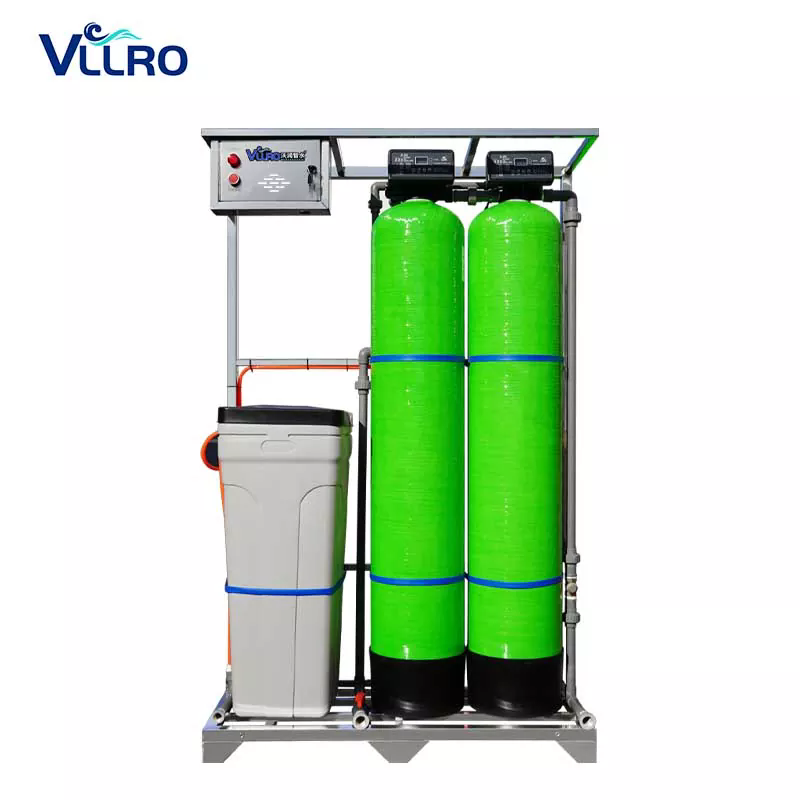
A typical multi-media filter system consists of several engineered components working together to ensure optimal filtration performance.
- Filter Vessel: A pressure-resistant tank that holds the filtration media.
- Filter Media Layers: Anthracite, sand, and garnet arranged by density.
- Underdrain System: Collects filtered water evenly and supports backwashing.
- Control Valves: Regulate inflow, outflow, and backwash cycles.
The performance of a system is highly dependent on the correct gradation of media layers. VLLRO designs ensure optimized media selection tailored to specific water conditions.
Key Advantages in Water Treatment Applications
Multi-media filtration offers multiple operational and economic advantages compared to conventional filtration methods.
- Higher Filtration Efficiency: Removes finer suspended solids effectively.
- Longer Service Cycles: Increased dirt-holding capacity reduces backwash frequency.
- Stable Water Quality: Consistent effluent quality under fluctuating influent conditions.
- Energy Efficiency: Reduced pressure loss improves operational efficiency.
- Low Maintenance Requirements: Simplified cleaning and regeneration processes.
These advantages make multi-media filters suitable for both pre-treatment and advanced water purification systems.
Industrial and Municipal Applications
Multi-media filters are widely applied across different industries due to their adaptability and reliability.
- Municipal drinking water treatment plants
- Industrial process water systems
- Cooling tower filtration systems
- Power plant boiler feed water pre-treatment
- Food and beverage manufacturing
- Desalination pre-filtration units
In each of these applications, systems supplied by VLLRO ensure stable filtration performance even under high turbidity conditions.
Operation and Maintenance Guidelines
Proper maintenance is essential for maintaining long-term filtration efficiency. Although multi-media filters are designed for durability, periodic inspection and cleaning are necessary.
Recommended maintenance practices include:
- Regular backwashing to remove accumulated solids
- Monitoring pressure differential across the filter bed
- Inspecting media condition annually
- Replacing or replenishing filter media when necessary
Proper backwashing ensures that the filtration layers remain effective and prevents channeling or clogging issues.
Performance Comparison Table
| Feature | Single Media Filter | Multi-media Filter |
|---|---|---|
| Filtration Depth | Limited surface filtration | Deep layered filtration |
| Dirt Holding Capacity | Low to moderate | High |
| Backwash Frequency | Frequent | Reduced |
| Effluent Quality | Variable | Stable and high clarity |
| Operational Cost | Higher over time | More efficient long-term |
Frequently Asked Questions (FAQ)
Q1: What contaminants can a multi-media filter remove?
It primarily removes suspended solids, sediment, turbidity, algae, and other particulate matter. It is typically used as a pre-treatment stage before advanced purification.
Q2: How often should backwashing be performed?
Backwashing frequency depends on raw water quality and system load, but typically ranges from once every 24–72 hours in industrial systems.
Q3: Can multi-media filters handle high turbidity water?
Yes, they are specifically designed to handle variable and high turbidity conditions due to their depth filtration capability.
Q4: What is the lifespan of filter media?
Under normal operating conditions, filter media can last 3–5 years before requiring replacement or replenishment.
Q5: Why choose VLLRO systems?
VLLRO systems are engineered with optimized media grading, durable vessel construction, and efficient hydraulic design, ensuring stable performance and long service life.
Conclusion and Contact Information
Multi-media filtration remains one of the most reliable and cost-effective methods for improving water quality in industrial and municipal systems. Its layered filtration mechanism provides superior particle removal efficiency, operational stability, and reduced maintenance demands. As industries continue to demand higher water quality standards, multi-media filters will remain a foundational technology in water treatment processes.
Solutions provided by VLLRO are designed to meet these evolving demands, offering engineered systems that balance performance, durability, and efficiency across a wide range of applications.
For more technical specifications, customized system design, or project consultation, please feel free to contact VLLRO. We are ready to support your water treatment needs with professional solutions and reliable engineering expertise.
Contact us at VLLRO today to discuss your multi-media filtration requirements and get a tailored solution for your project.